Goals and Objectives
I completed this project as a Product Designer for a regional healthcare system and insurance provider. The product is a piece of enterprise software used by clinical care managers on member cases that involve complex health conditions like CHF, COPD, Diabetes, and others. Users outreach to health plan members, engage them in dialogue about their conditions and offer interventions in the form of a variety of health plan benefits.
The goal of this project was to help users recognize and monitor actions they trigger during these member interventions, so they can better assist the health plan’s members recover from hospitalizations and manage their complex health conditions.
My objective was to discover opportunities for improvement in the next version of the product. To do this, I would need to learn as much as possible about the various actions users can trigger while assisting members, then iterate on concepts to help improve these processes and turn those concepts into backlog items for our stream-aligned product development teams.
Background
While assisting members, care managers can use the product to take critical actions on behalf of the health plan members they serve. Most of these actions involve items or services they can order for the member. Users need to be able to monitor and track these orders, and sometimes intervene with third-party vendors to make sure they are fulfilled properly.
So, what is an action and how is it triggered? Actions include letters that are mailed when a member can’t be reached by phone. They include mailings that are sent when a member agrees to participate in a condition management or wellness program. One action involves ordering frozen meals to be sent to a member who is home recovering from a hospital stay. Users might order a pill box or pharmacy delivery service to help a member manage their prescriptions. They might order durable medical equipment like safety rails or a shower chair to keep the member safe at home. Or they might arrange transportation to and from follow-up doctor appointments. Sometimes the actions are obvious to the user. Other times they are triggered behind the scenes, with no clear notifications of what was done.
Some of these are critical actions to help members manage their conditions or recover from serious health issues, while others allow the health plan to earn compensation from the federal government. So from both a business and user perspective, this is an important problem to address.
The UX Lead assigned me to identify all of the actions that could be triggered through the system and provide recommendations on making these processes more consistent and intuitive, as well as provide notifications on the status of orders placed for the member.
We also wanted to learn how users would be notified when new member assignments came into the system, as well as how they could complete the loop by communicating back to the member’s PCP.
Approach
Since I had just completed Human-Centered Design certification with the LUMA Institute, it seemed like the perfect opportunity to put some of my new skills to use and test out the LUMA system on a real project.
Every design method I used on this project comes from the LUMA system. I used their Miro templates as a guide and collected all of my work in one giant Miro board. At each step along this project, I chose methods from this list:
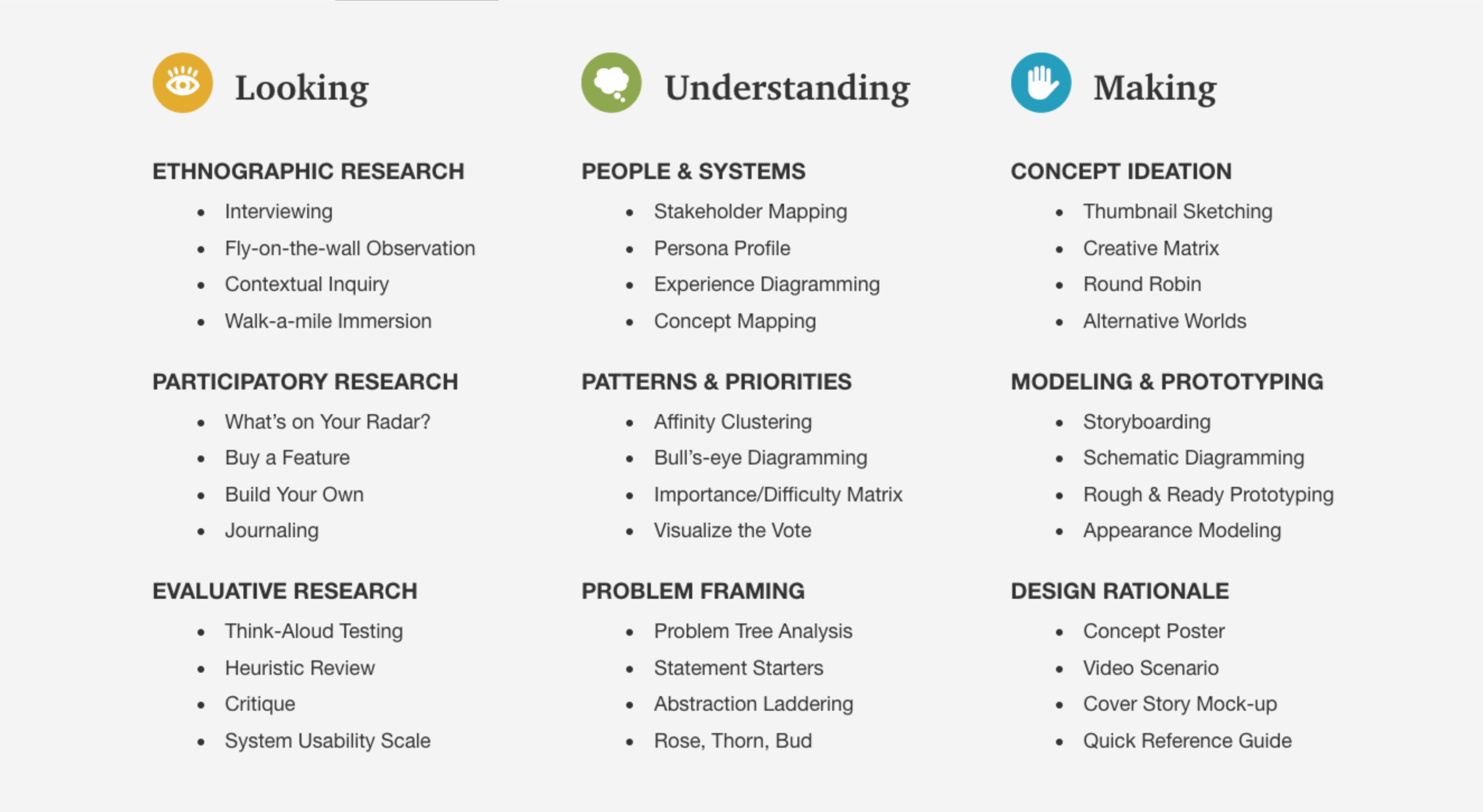
To make the most of the system, I created a combination of methods, known as a Recipe. At the beginning of the project, my recipe consisted of the following methods:
- Stakeholder Mapping
- Interviewing
- Heuristic Review
- Affinity Mapping
- Experience Diagramming
- Rose, Thorn, Bud
These methods are not unique to the LUMA system, but the power is in combining them to achieve a specific outcome. The outcome I was looking for was a set of research-informed recommendations for product improvements.
Process
Prior to my first method, I examined the existing Epics and Features related to this project in Azure DevOps. These provided a clear roadmap for which workflows I was going to research and the product team’s current understanding of the problems we needed to solve.
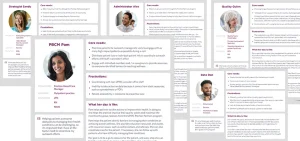
Stakeholder Mapping. I started here so I could understand who I would be working with and get a sense of how their interests and responsibilities relate to each other and our purpose. I used the LUMA template to build a list of possible stakeholders and laid them out with an icon and a speech bubble that helps explain their role and perspective.
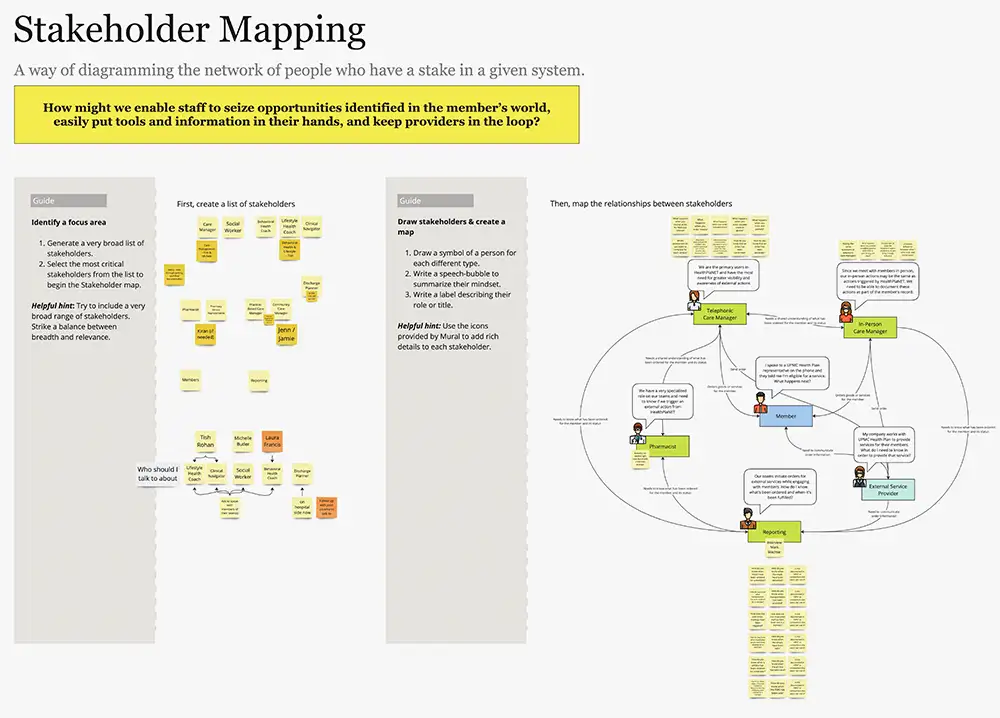
It was important to consider the member as being the central figure in this map, as well as external service providers, who are not on our team but are an important part of the process.
As I started to draw connections between these stakeholders, I gained a better understanding of how they interact or are affected by each other’s actions.
This method helped me create a list of people to invite to interviews, and I started adding stickies with possible questions to ask.
Note: I was not allowed to speak directly to current users during my research. Instead, I relied on the experience of Subject Matter Experts on my team who were former Care Manager users.
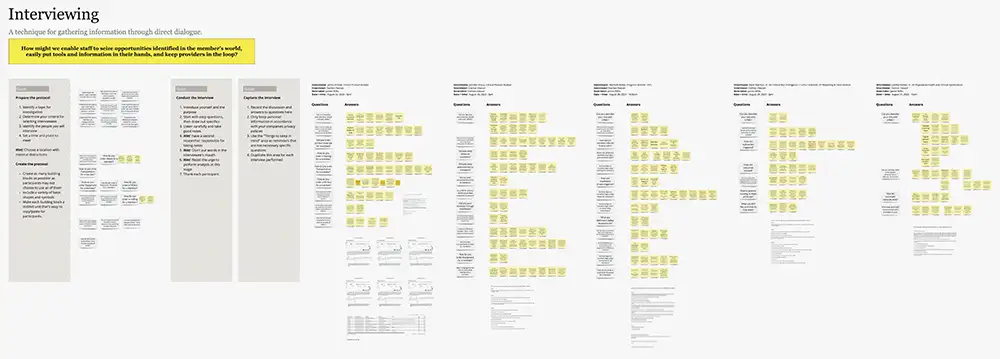
Interviewing. I interviewed five stakeholders and SMEs. While preparing for the interviews, I used the LUMA template to organize my questions so I could just follow the board as the interview progressed. The Product Manager was taking notes, but I also recorded each session to make sure I didn’t miss anything.
After each interview, I went through the transcript and put everything that I could on the Miro board, organized by question to retain the context. If questions came up during the conversation, I added them to the board as well, along with the PM’s notes and documents or screen captures provided by the interviewees.
Heuristic Review. A heuristic is a generally accurate guideline based on the experiential knowledge of how something works best. Sometimes we refer to these as a Rule of Thumb.
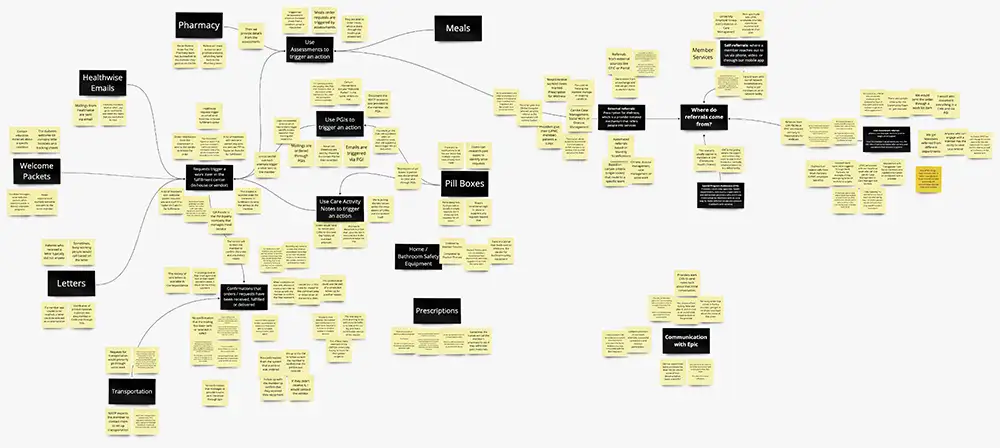
One of my SMEs guided me through a review of the current state system, noting specific parts of the workflow where actions are triggered. I took notes during the session, then used the LUMA template to organize my observations by the following list of heuristics:
- Match mental model
- Minimize perceived complexity
- Use consistent form, words, and actions
- Provide a sense of place
- Account for user and environmental constraints
- Anticipate needs
- Use clear and concise language
- Give feedback about actions and status
- Prevent errors and provide graceful recovery
- Strive for appropriate and minimal aesthetics
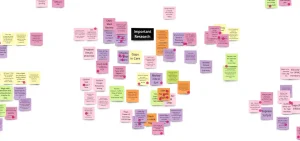
Affinity Clustering. The PM and I then used this method to cluster all of the notes from the interviews and heuristic review into meaningful groups, eliminating duplications and grouping everything around common themes.
Once the clutter was turned into clusters, I was able to draw connections between them and see how these themes were related. Insights included:
- Users lack confirmations when their orders have been received by downstream vendors, as well notifications when an order has been shipped or delivered.
- Members have no information about their items, unless they are directly involved in the ordering process. In most cases, the user must contact the member to confirm receipt of the item.
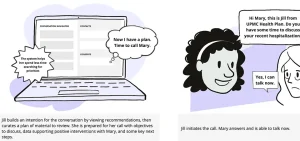
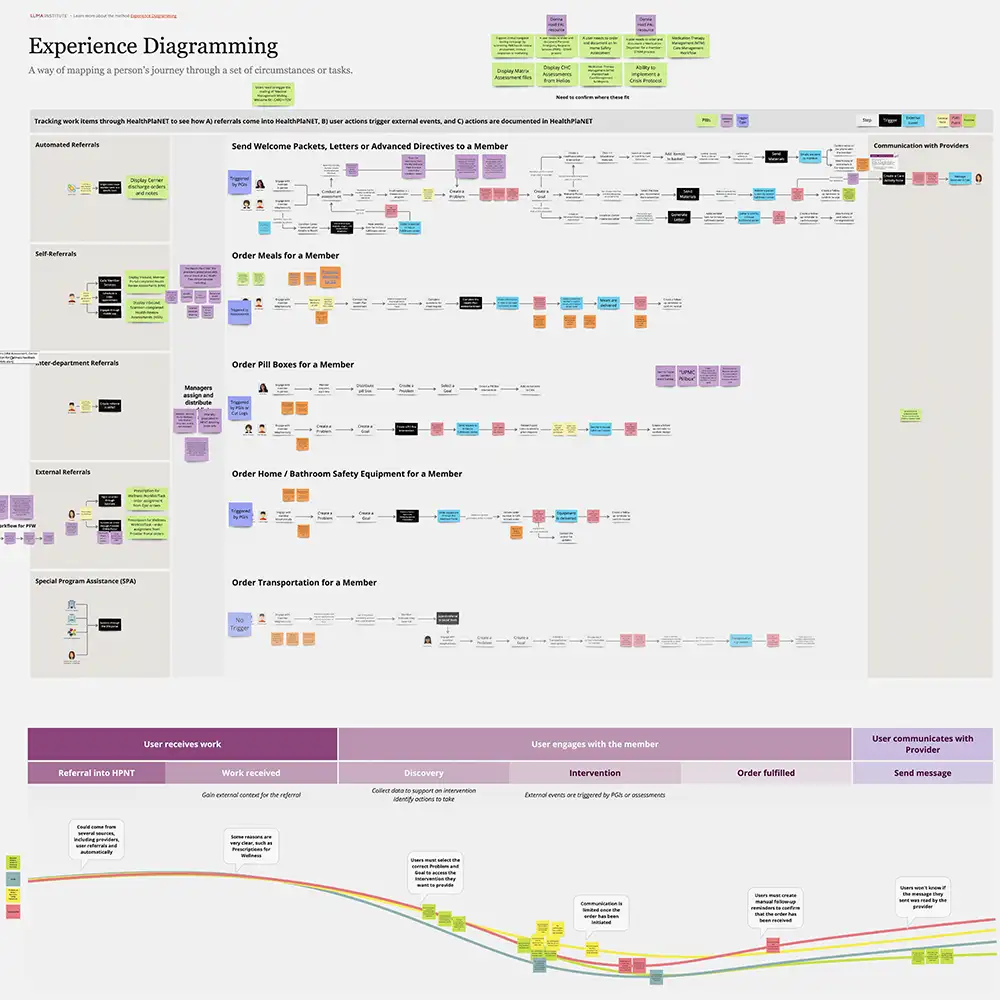
Experience Diagramming. I started with a list of all the workflows I identified in Azure DevOps and mapped out each one, identifying the stakeholders who would be involved (by persona) and following the member’s journey as they were referred to a team in the system, picked up by a user, the engagements that resulted in actions being triggered, and communications sent back to the member’s doctor.
I was able to combine Welcome Packets, Letters and Advanced Directives into one workflow, and Pill Boxes and Home / Bathroom Safety Equipment into another.
Once I had them all in place, noting the pain points I had observed during interviews, I realized I could organize them into three main stages, how the user receives work, how they engage with the member and how they communicate with providers. Most of the workflows fit pretty well into this journey map with the steps represented by speech bubbles along the way. The color-coded journey lines follow the user’s stress level or emotional state as they complete the steps, which helps indicate where they run into pain points, and where we might try to improve the design.
Rose, Thorn, Bud. At this point, I presented my findings to a group of product managers and UX designers. Unfortunately, I don’t think I presented the exercise effectively because most of the feedback focused on the presentation, rather than possible insights.
At this point, I realized I had to add methods to my LUMA Recipe to achieve my objectives. I planned out four more methods:
- Statement Starters
- Round Robin
- Thumbnail Sketching
- Storyboarding
After some minor delays, I changed my recipe again.
Creative Matrix. In order to begin converging on solutions after the divergent discovery process, I facilitated a Creative Matrix workshop with a group of Product Managers and UX Designers. This method is great for generating many wide-ranging ideas in a short amount of time.
The structure of the matrix provided a framework for generating new ideas where topics intersect. I led the group through a series of human-centered problem statements by comparing each one with a solution category. Then, we worked quietly to add ideas, questions, and considerations in each category. When we finished, each participant discussed their favorite idea on the board.
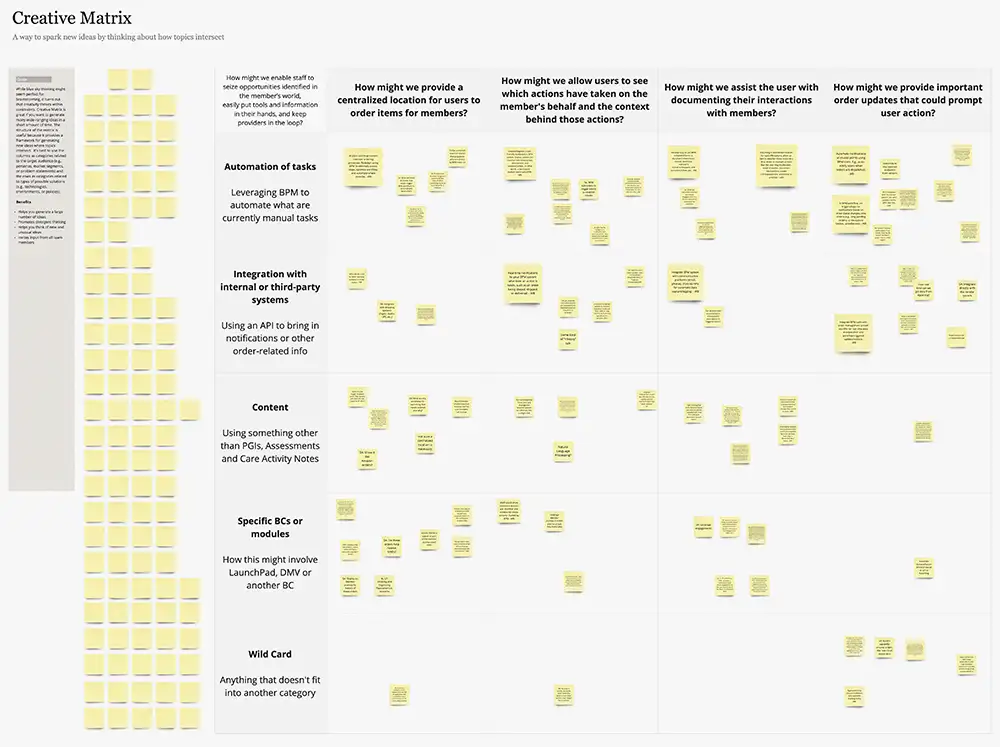
After the exercise, I did some more affinity mapping to organize the ideas into common themes and insights. This helped me visualize the kinds of solutions that could have an impact on the product.
Results
The last step was a combination of the Thumbnail Sketching and Storyboarding methods to create a series of low-resolution designs to introduce new concepts as potential solutions.
I kept these new concepts low-resolution to keep the focus on the concept itself, rather than a specific feature or page layout. The first one was as follows:
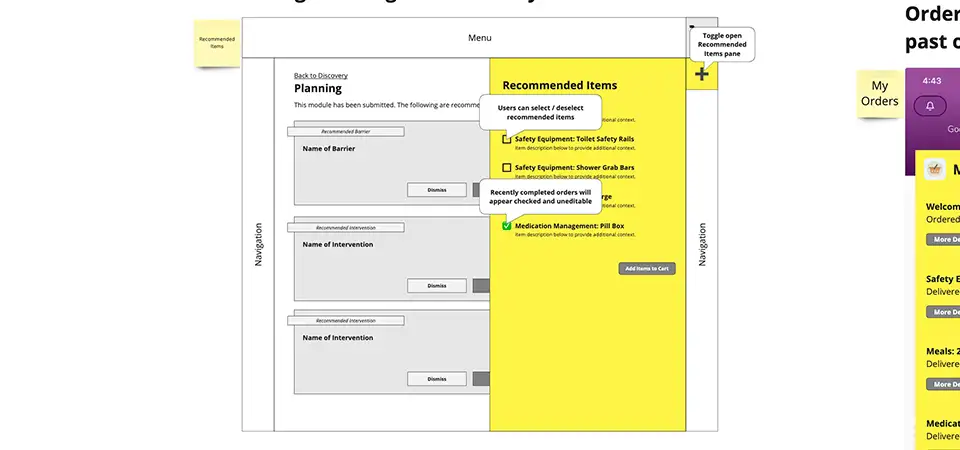
- Create a unique system object called an “Order”. Orders would package information about the item, including the order date, which user placed the order, the product ID, description and price, the order confirmation from the downstream system, as well as package tracking and delivery information. I created an accompanying flowchart to explain how users would initiate the creation of an Order object based on novice and expert workflows.
- Provide notifications at key stages in the order / fulfillment process (an experience similar to common e-commerce applications). It also provides information to members, so they can have an e-commerce-like experience after an item has been ordered on their behalf.
- Use the new Order object to display order information to the user, reducing time and effort spent on research prior to an engagement with a member.
I presented the concept as it would be seen by the user in the product, as well as how the member would receive information through the myUPMC app.
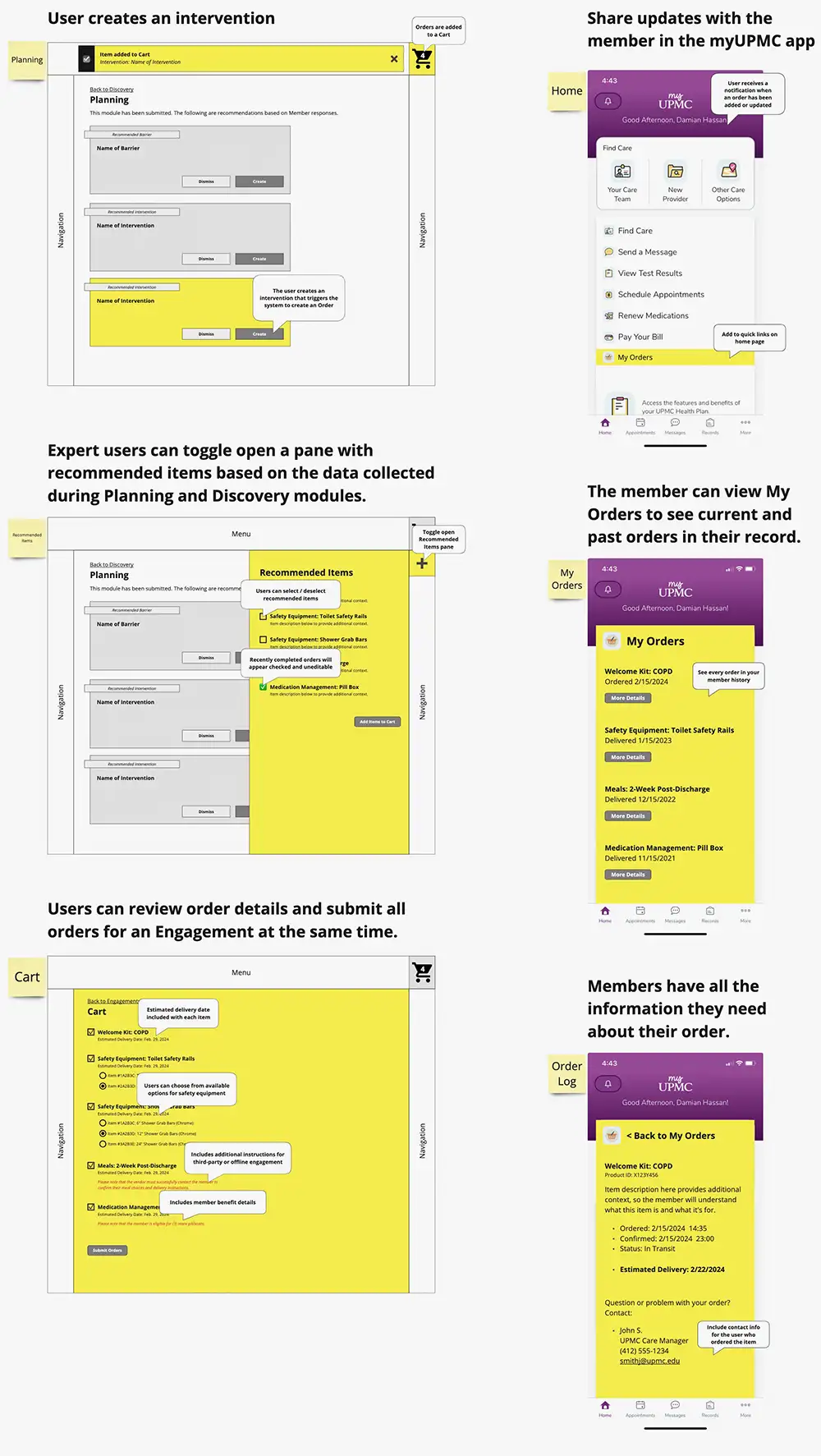
Ultimately, I contributed these concepts to a pool of concepts that the Senior Product Managers, UX Leads, Architects, and I used during a full examination of the end-to-end experience for our next version of the product.
We turned one of my concepts into a series of backlog items that were picked up by one of our product development teams. I then worked with the team’s UX Designer to turn the concept into wireframes.
Conclusions
At the end of the project, I had an opportunity to consider whether my process helped me to meet my objectives, and how I might do things differently in the future.
First off, I found the LUMA system to be very effective. Having a clear plan from the beginning gave me the confidence I needed to take on a leadership role with this project. It helped me earn the trust of my colleagues and stakeholders and deliver concepts to achieve our goals.
That said, choosing the right recipe from the outset was harder than it looked. I felt overwhelmed at first, not knowing what to choose. Early feedback from my LUMA cohort was helpful, and later feedback from my UX Lead and manager helped me stay on track.
If I could tie the work to a specific KPI to measure our success, it would have to do with the amount of time it takes a user to fix a problem with an order. For example, if a user ordered frozen meals for a member and they didn’t arrive, how long would it take for them to realize there was a problem with the order and fix it?
I am glad that Damian was able to step in and support CWS in exploring some of the sub-processes related to executing interventions and ordering items. I think that we were previously trying a shortcut method of solutioning and it did not include a full understanding of the actual needs and opportunities.
Rebecca Maners, Sr. Product Manager