Objective
Help the Director of Product Development communicate the product vision to all Product Managers, UX Designers and Architects, assess the current roadmap for Product Development, identify gaps in key features and rally the team around an agreed-upon end-to-end experience.
Background
The product team includes seven stream-aligned teams. Each team is an autonomous, cross-functional group of individuals, including developers, designers, a Scrum Master, and a Product Owner, who are assembled to deliver business value through the end-to-end delivery of a business capability.
The stream-aligned teams focused on individual features for a new version of the product, but lacked a single artifact that clearly articulated the complete end-to-end user experience. Leadership felt that the product could not move forward until a more cohesive experience was achieved.
The Director of Product Development asked me to work with the Sr. Product Managers and UX Leads to define the current end-to-end experience, align current features to support that experience and identify gaps in functionality. The Product Managers, UX Leads and Architects could then work together to create features that would bridge those gaps, update the product roadmap, redesign the wireframes/prototypes and readjust team backlogs as needed.
Process
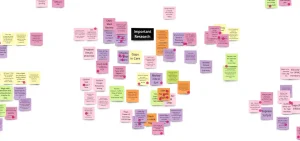
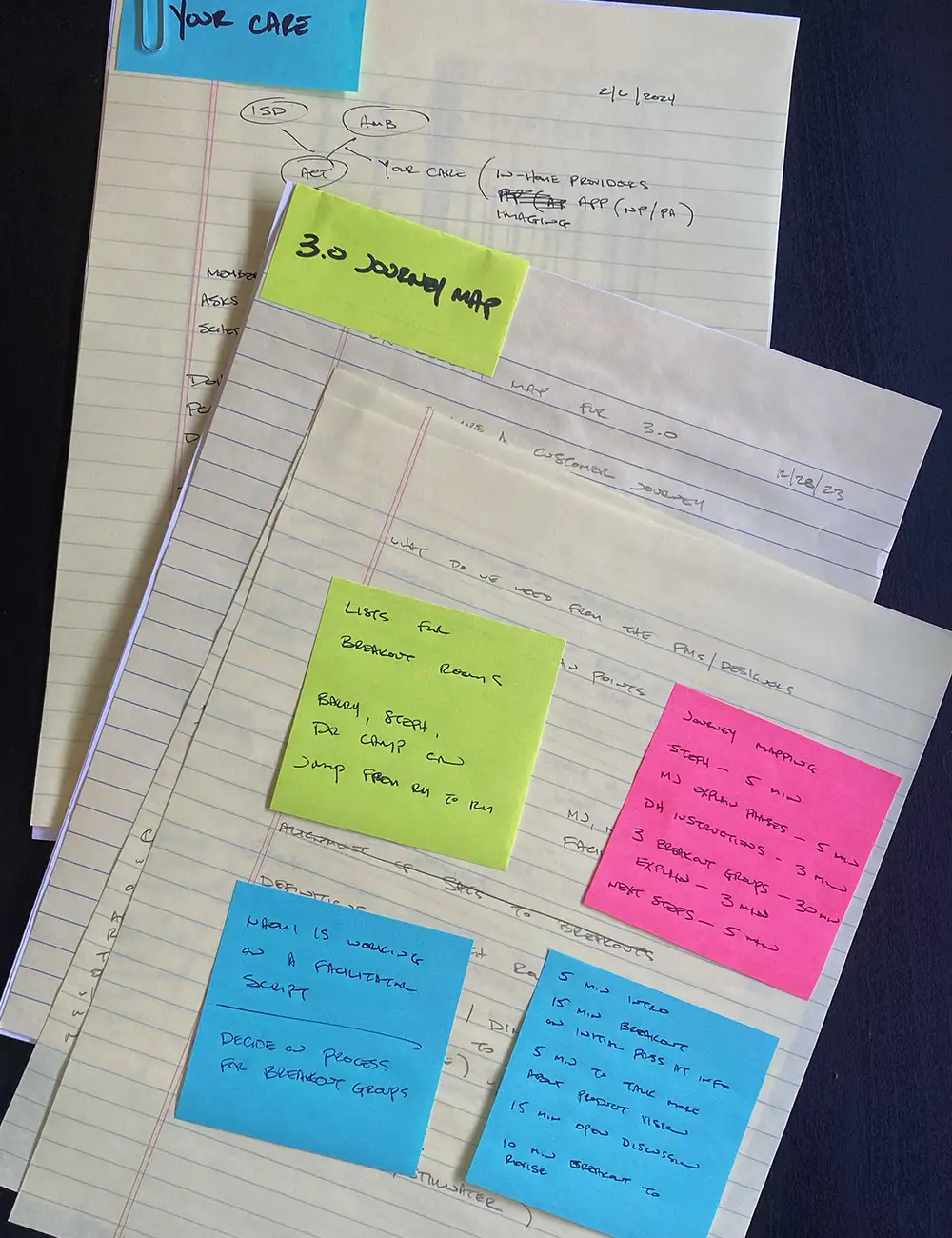
To provide a high-level understanding of this experience, I facilitated a series of workshops where Product Managers, UX Leads and Architects collaborated to create a step-by-step flow of how a typical user conducts their daily work.
We divided the end-to-end experience into three phases – Manage, Prepare and Act. Based on these phases, the UX Lead provided a brief description of what happens during each phase.
We then organized this information into a matrix where we would capture information on user-centered topics such as User Activities, Goals, Touchpoints and Pain Points. We also collected data on business-centered topics such as Business Goals and KPIs, Technology Systems and Potential Opportunities.
During the workshops, we divided into breakout groups by phase. I assigned most of the participants to the phase where they had the most direct knowledge or hands-on experience. This assignment strategy allowed the Product Managers and UX Designers to provide specific and valuable input on exactly what happens at each step of the process.
After three sessions, we had filled in each cell of the matrix and had a complete, detailed account of the current end-to-end journey from both a user and business point of view.
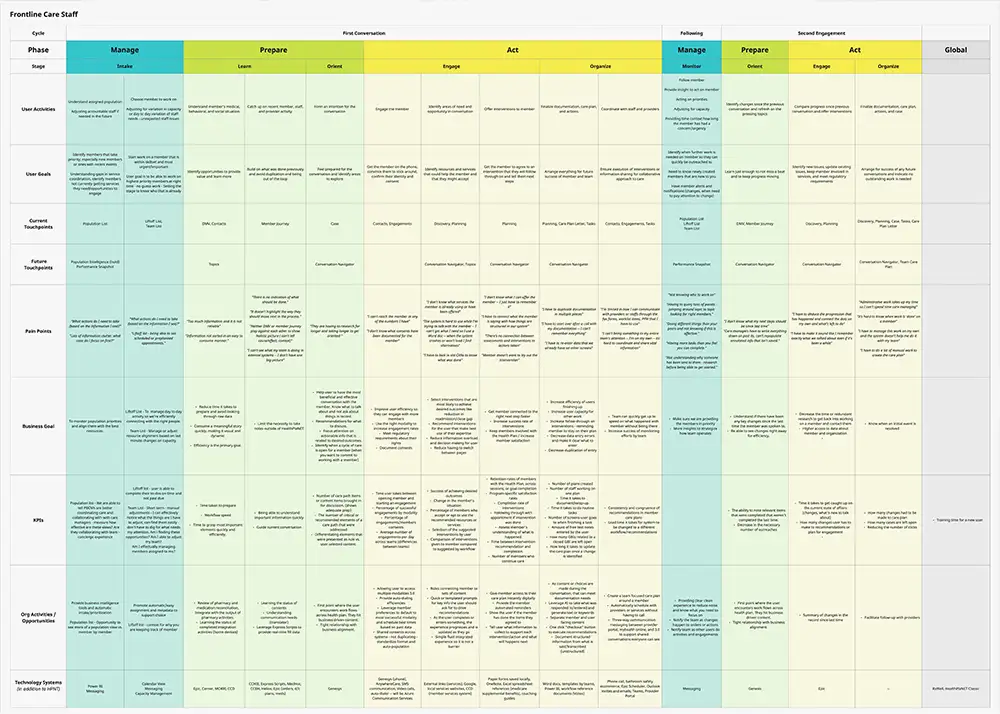
To provide a high-level understanding of this experience, I facilitated another series of workshops where Product Managers, UX Leads and Architects collaborated to create a step-by-step flow of how a typical user conducts their daily work.
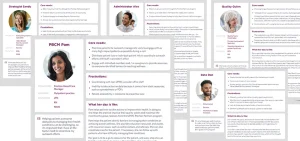
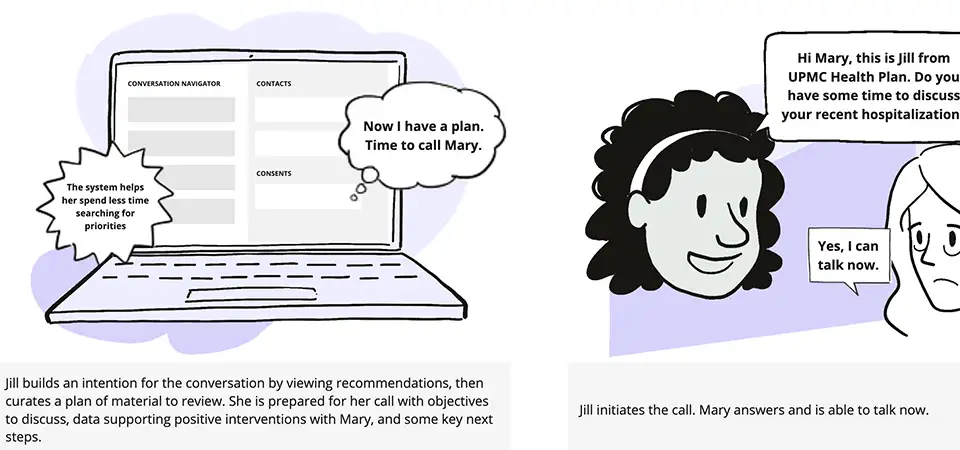
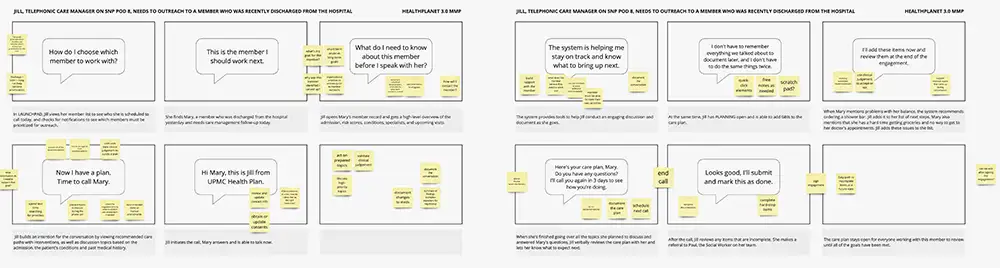
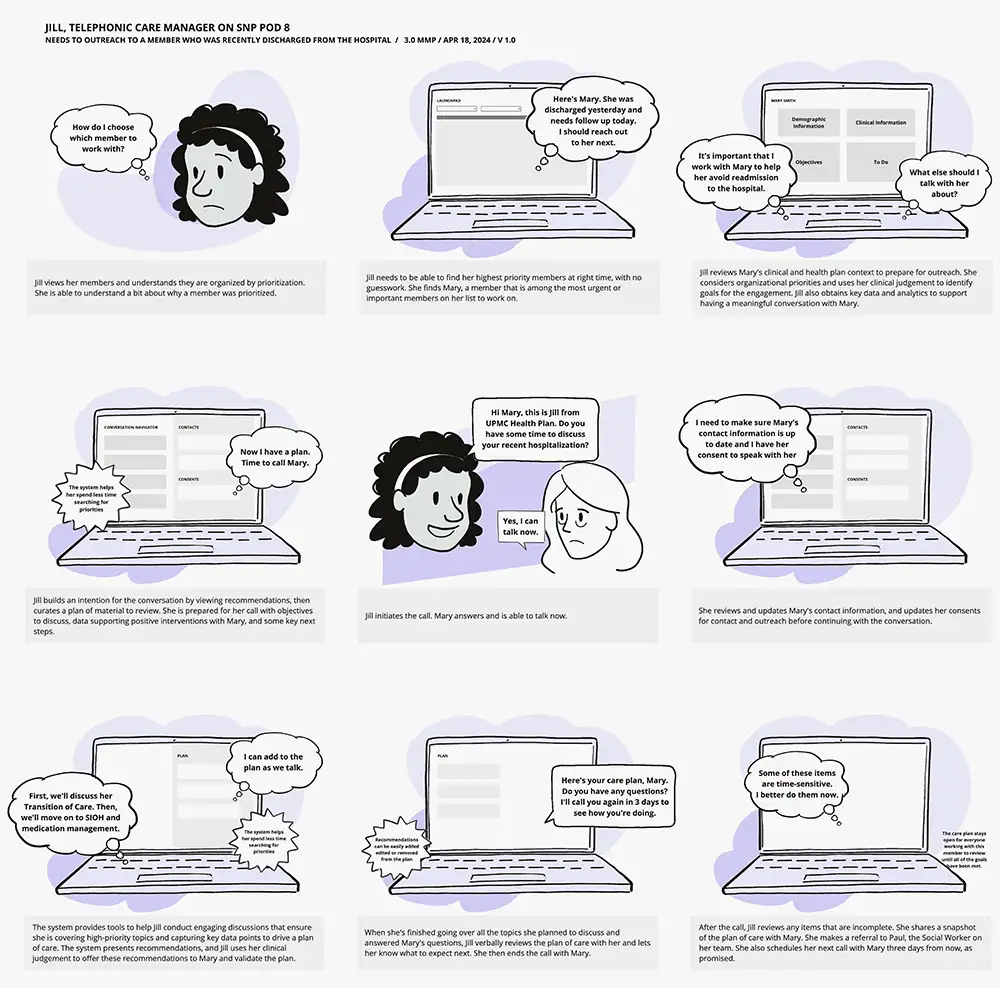
Together, we created a storyboard based on the Care Manager persona and her experience with a member in a realistic narrative.
I mapped out a simple storyboard in Miro with a sentence or short paragraph to describe the action at that step, then a quote to illustrate what the user was saying or thinking.
This format allowed the group to have detailed discussions on how the product currently supports that experience, and what might be missing. As the facilitator, I had to provide room for everyone to engage via Microsoft Teams, whether out loud or in the meeting chat. I took detailed notes and revised the storyboard as the meeting went on to document the changes we discussed.
Rather than focus on specific features that are in current use or in development, we wrote the story based on what the user needs to do at each stage of the flow.
Afterwards, I added illustrations and other graphics to complete the artifact. We met again to review, ask questions, make revisions and take a vote of confidence on the artifact.
Results
Based on the finished artifact, the Sr. Product Managers defined specific tasks the user would need to complete at each step to achieve the activities outlined in the storyboard. They then worked with the Architects to define requirements for supporting features.